Відповідь УкрНДІЛГА на звернення EDGG / The answer of Ukr.SRIFAM to request of EDGG
Апр 9th, 2012 by stepan
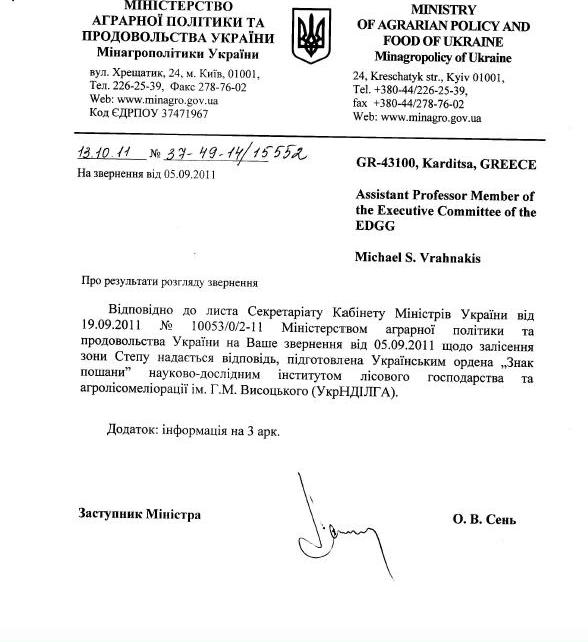
Ministry of Agrarian Policy
And Food of Ukraine
Minagropolicy of Ukraine
24, Kreschatyk str., Kyiv 01001
Tel. +380-44/226-25-39
Fax +38-044/278-76-02
GR-43100, Karditsa, GREECE
Assistant Professor Member of
The Executive Committee of the EDGG
Michael S. Vrahnakis
13.10.11 № 37-49-14/15552
On appeal from 5.09.2011
About results of the appeal consideration
According to the letter of the Cabinet of Ministers of Ukraine dated 19.09.2011 Ministry of Agriculture and Food of Ukraine on your appeal from 05.09.2011 № 10053/0/2-11 about afforestation of the Steppe zone provided a response prepared by Ukrainian Order “Badge of Honor” GM Vysotsky Research Institute of Forestry and agroforestry (URIFFM).
Appendix: Information on 3 sheets.
Deputy Minister O.V. Sen
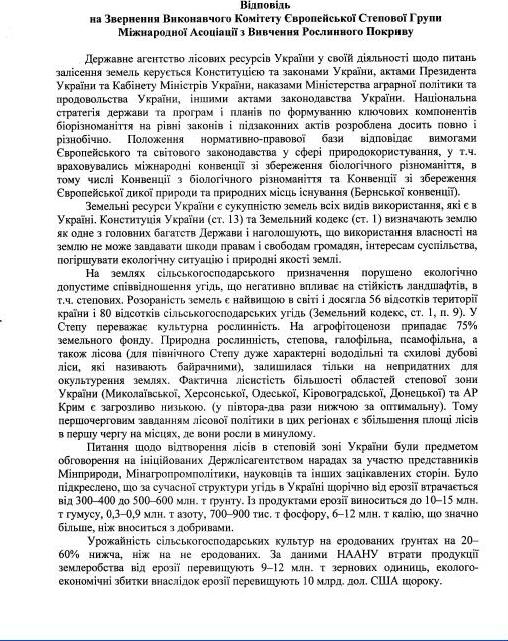
Response
to the Appeal of Executive Committee of the
European Dry Grassland Group of the International Association for Vegetation Science
State Agency of forest resources of Ukraine in its lands afforestation activities follow the Constitution and laws of Ukraine, Decrees of the President of Ukraine and Cabinet of Ministers of Ukraine, Ministry of Agriculture and Food of Ukraine, other legislative acts of Ukraine. The National Strategy of State also programs and plans on implementing of key components of biodiversity at the level of laws and regulations developed sufficiently and comprehensively. The provisions of the regulatory framework meets the requirements of European and international legislation in the sphere of nature management taken into account, including international conventions on biological diversity, including the Convention on Biological Diversity and the Convention on conservation of European wildlife and natural habitats (Bern Convention).
Land resources of Ukraine is a combination of all land uses that are in Ukraine. Constitution of Ukraine (Article 13) and the Land Code (Article 1) defines the land as one of the main wealth of the State and emphasized that the use of land ownership can not cause harm the rights and freedoms of citizens, interests of society, make worse ecological situation and the natural qualities of land .
For farm land is violated environmentally acceptable land ratio, which adversely affects the stability of landscapes, including steppe. Plow the land is highest in the world and reached 56 percent of the country and 80 percent of agricultural land (Land Code, Art. 1, § 9).
In the Steppe is dominated culture vegetation. At agrophytocenoses occupy 75 percent of land stock. Natural vegetation, steppe, halophylous, psamophylous and wood (for the northern steppe is typical platoes and slope oak forests, which are called ravine), remaining only on lands unsuitable for cultivation.
The actual forestation most regions of the steppe zone of Ukraine (Mykolaiv, Kherson, Odessa, Kirovograd, and Donetsk) and Crimea are dangerously low (one and a half to two times lower than the optimum). Therefore, the primary objective of forest policy in these regions is to increase forest area primarily at places where they plant in the past.
The issue of forests renewal in the steppe zone of Ukraine were discussed at the State Forest Agency initiated meetings with representatives of the Ministry of Environment, Ministry of Agrarian Policy, scientists and other stakeholders. It was pointed out that in the current structure of land in Ukraine is lost every year from erosion from 300-400 to 500-600 million tons of soil. Of the products of erosion removed up to 10-15 million tons of humus, 0,3-0,9 million tons of nitrogen, 700-900 tons of phosphorus, 6-12 million tons of potassium, which is much more than is brought to fertilizers.
Yield of crops on eroded soils on 20-60 percent lower than on not eroded. According to the National Academy of Agrarian Sciences of Ukraine agriculture production losses from erosion exceed 12.9 million tons of grain units, ecological and economic losses due to erosion exceed $ 10 billion.
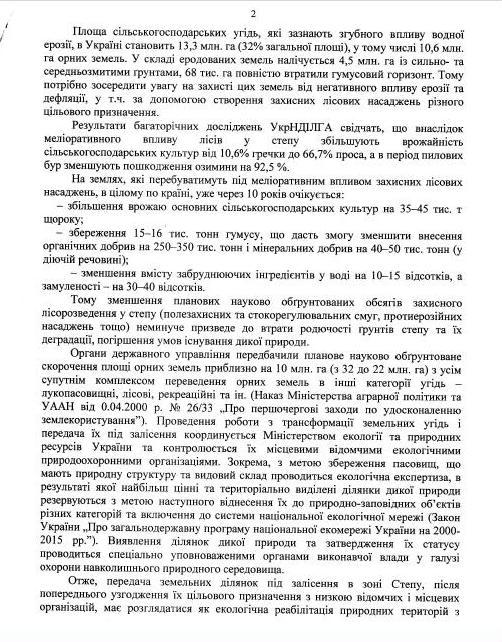
The area of agricultural lands exposed to negative influence of water erosion is 13 millions ha (32 % of total area), among them 10.6 millions ha of plough-lands. Eroded lands also include 4.5 millions high-washed-out and mid-washed-out soils and 68 thousands ha which have entirely lost humus horizon. That is why it is necessary to pay attention for protection of these lands against negative influence of erosion and deflation; this protection also includes making of protective forest plantations of various target assignment.
The results of long-term researches made by Ukr.SRIFAM (Ukrainian Scientific-Research Institute of Forestry and Agricultural Forest Melioration) show that the forests in the steppe make meliorative effect which increases the yield of crops from 10.6 % for buckwheat to 66.7 % for millet, and it decreases the damage of dust-storms for winter wheat by 92.5 %.
Already in 10 years on the lands exposed to meliorative effect of protective forest plantations it is expected the following:
– Increase of yield capacity of main crops by 35,000-45,000 tons every year.
– Saving of 15,000-16,000 tons of humus, that will enable to decrease the application of organic fertilizers by 250,000-350,000 tons and mineral fertilizers by 40,000-50,000 tons (in active ingredient).
– Decrease of pollutant concentration in water by 10-15 %, and bottom mud by 30-40 %.
That is why the decrease of planned and scientifically-based volume of protective afforestation in the steppe (wind-belts and other anti-erosion plantations) will cause the loss of steppe soil fertility and ground degradation, the decline of conditions of existence for wildlife.
State agencies have elaborated gradual and scientifically-based decrease of plow-land areas approximately by 10 millions ha (from 32 mil. to 22 mil. ha) for transformation of them into other land categories: meadows and pastures, forests, recreation territories and other. (Order of Ministry of Agricultural Politics and Ukrainian Academy of Agrarian Science No26/33 dated April 2000 “About urgent measures for land application improvement”).
The process of land transformation and its delivery for afforestation are held and coordinated by Ministry of environment and natural resources of Ukraine and are controlled by local official departments of this state body. Moreover, for the purpose of saving of pastures, which have natural structure and species compound, it is fulfilled ecological expertise in result of which the most valuable and territorially separated areas of wildlife are reserved for the following transformation them into objects of natural-reserved fund of various categories and for including them into the system of national ecological network (the Law of Ukraine “About countrywide program of national ecological network of Ukraine for 2000-2015). Discovering of wildlife plots and approval of their status are made by special authorized bodies of executive branch of government in the sphere of environment protection.
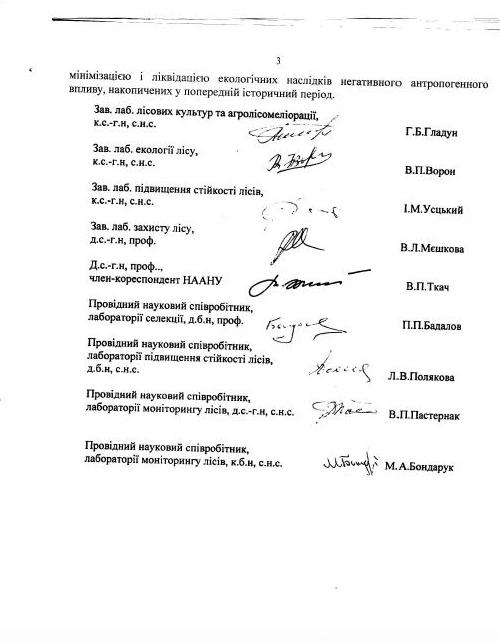
So, delivery of land plots for afforestation in the Steppe Zone, after preliminary approval with several local and administrative establishments of their target assignment has to be considered as an ecological rehabilitation of natural territories together with minimization and liquidation of ecological consequences of negative anthropogenic influence, that was made in previous historical period.
Head of Forest crops and agricultural forest melioration laboratory G.B. Gladune
Head of Forest ecology laboratory V.P. Voron
Head of Forest resistance laboratory I. M. Ustskyy
Head of Forest protection laboratory V.L. Meshkova
Associate Member of National Academy of Agrarian Sciences V.P. Tkach
Senior research scientist of Selection laboratory P.P. Badalov
Senior research scientist of Forest resistance laboratory L.V. Polakova
Senior research scientist of Forest monitoring laboratory V.P. Pasternak
Senior research scientist of Forest monitoring laboratory M.A. Bondaruk